Tuesday, 1 February 2011

Conventions of an Opening Sequence Post 1

The Ring


The Ring's opening sequence is that of a short story in itself. It doesn't conform to every convention when it comes to opening sequences in general, but in terms of horror, it does. It remains without titles to leave the opening sequence's story as your main focus. The titles come after. It has a lot of dialogue which again isn't usually the norm when it comes to opening sequences.

Lolita


Lolita's opening sequence is the ideal example of a stereotypical opening sequence with titles. It is in black and white which adds an extremely 'classic' feel along with the style of font. It is basic, yet elegant with a very standard almost motionless picture as the background.

Other Targets

Beyond learning what skills I have developed through the preliminary task, I also became aware of things that are in need of developing in order to be successful on my main coursework task.Firstly I want to improve in the area of lighting. This is a key area I want to develop in mainly because our group had problems with lighting in issues of continuity in our preliminary task, and it makes a huge effect on the outcome of the piece. I will assure that continuity factors to do with lighting is avoiding by watching making sure the camera is not moved within filming at a certain angle, and logging exactly where it is if moving is necessary. Also, if possible, I will avoid filming on different days, therefore the natural light will be near enough the same in each shot that is filmed. If as a group we do this, when at post production stage our shots will run smootly and will avoid any situations that we encountered in that we had to add extra shots to avoid the audience drastically noticing.Another target I want to set myself is with blogging. I want to not only become more urgent with my blog, in the sense that I will spend more time on it so all of my ICT is verbally correct and it is of a high standard, but I want to get my blog finished quicker so I can spend more time on the production stages itself. Doing this will allow me more time to perfect the visual side of coursework, yet gain high marks on my blog due to the standard of my blog. This target should be done weekly; I will dedicate more time to my blog so that everything is completed in more time.Another element I feel can be improved in is team organisation. We worked well as a team, yet at times lack of organisation confused situations and wasted time. Therefore, if as a team we are more accurate and precise when planning a task and dedicate certain jobs to certain members of the team, we will be making good use of our time and will have a good outcome on our final piece. This target will have to be performed by all members of our group to assure that it is done well, therefore will start immediately. I also feel I can improve at the stage of logging rushes. We encountered a problem when logging rushes on our preliminary task; although we had a clear understanding of what we had to do, we didn't ensure our shots were visually perfect before logging therefore we wasted alot of time logging irrelevant footage. To avoid this in the future, I will ensure that our whole team is present when watching the final rushes, so that we can stress our concerns and re-shoot the footage if necessary before logging the rushes. This will be done within the production stage of future projects.The final area in which I would like to improve in is script writing. Initially the group was unsure of creative ways of portraying our chosen genre, alongside acheiving the dedicated layout of a script. Therefore I will go over and learn the ways of setting out the script so that this is not a problem when writing one. However my main target for script writing is to get more creative within the script itself so that our genre is presented adamently.

Post-Production

Final cut of Preliminary Tast - 'Doctors'


  • The preliminary task has been a success in the way that it has broadened my knowledge and developed my skills in understanding how to produce a short piece of film. This is the case for technical skills, creative skills and personal skills.

Evaluation of skills developed


The preliminary tast has helped train my skills within the technical areas, particularly within editing. Although within the production stage itself, I had a small input when it came to the filming but still had to make sure the shots were accurate. I already knew the basic skills in making sure continuity factors wouldn't affect the audiences' viewing, however I now know that it can happen with even tiny factors. Not only with visual elements; hair, costumes, setting and props, but with the shot styles and lighting. Now I have had the experience and moreso dealt with issues of continuity on the preliminary task, I know that more planning and concentration is needed in order to avoid these issues in the first place. Also it has developed my skills in using acting infront of a camera, and gaining an understanding of what angles and positions make a good shot. Particularly, however, my skills in using the editing suite have been developed. As a group we used alot of elements in the editing suite therefore became aware of the types of things we could manipulate within the programme. My creative skills have developed in a way that within the preliminary task we tried to think outside the box and avoid stereotypical shots within a genre. Creativity has broadened in the way of music choices, and more than else elements within a sequence that portray the chosen genres.

Production Report

After viewing all the rushes, we were satisfied with how our footage turned out. We booked the editing suite and began logging the rushes. We hit a few problems after logging all our rushes as we realised we needed to re-shoot some of our shots. With this in mind, many of our logged rushes became irrelevant and time became limited. We logged the rushes in table format with seven different columns, making it easily identifiable and straight forward. Beyond doing this, we went through the footage and constructed a rough cut of the visuals, alternating between the two video tracks again making the editing process easier. We alternated between the group members to ensure that all of us could have a go on the editing suite, and as a rough cut we were pleased with the outcome. We did have some issues of continuity, such as the lighting in many of the shots. Some shots went from very light then to immediately very dark, something which as a group we werent happy with. To solve this, we added short shots in the places where lighting changed, making the difference less obvious to the audience. After adding transistions between each shot on our rough cut and making it visually pleasing, we added the title at the beginning of the piece and credits at the end. To fit with the mood and tone of the piece, we wanted simple titles consisting of a plain black background with white captial letters. this gave no distraction to the mood we wanted to acheive when watching the piece. Similarly to create a more intense mood, we searched for some appropriate eerie music to add to the opening titles. When we found our chosen music, we added it to the audio track, fading up and down between the shots at the opening of the piece and the end. By doing this we acheived the genre and mood that we aimed for when planning the preliminary task and we are all pleased with the final outcome.

Friday, 19 November 2010

Pre-Production Documentation

Location Recce:

Technical Recce:
As the room we are using is of a small size there were no reastrictions ion shooting. for the look we wanted we had to add a few features into the room such as a table and a chair, as these were our largest props.

Risk Assessment:
If there was a fire there are 3 exits out of the room, one is the main entrance, the second into a second room and there is a third door leading into the 3rd room.

There is a table in the room and somebody may bump into them causing themselves injury, to avoid this, all of the crew need to be warned about the hazard and act sensibly at all times.

The chairs could be tripped over if they are not tucked away properly; all chairs need to be moved out of the way once they have been used.

Power supplies could be a risk if they are left on and touched. All power supplies need to be noted and all the back stage crew and actors need to have a wear of where they are.

We need a risk assessment so that we can see what risks there are during the filming and how we can avoid any injuries.

Shooting Schedule:
Our shooting was organised in a lesson and we decided as a group that we would shot on tuesday in our second media lesson. The location was organised previously and we started filimg at 11 o'clock. We shot the scene and we finished filming at 1:30, the shooting was successful.

Mise-en-Scene:
Lighting:
In the TC block corridor there is a main door which will provide manmade natural sunlight, this will brighten the room enough to make it look cell like.

Props:
There will be one table acting as a bed for the patient with a duvet over the top, we will also need a black curtain to cover over the door that comes into shot.

Costume:
LIAM- Lab coat backwards to look like patient.
JACK- White lab coat, with black trousers.
With these costumes it fits the theme of the characters and more authentic.

Hair and Make-Up:
LIAM - Hair will be messy, face will look tired.
JACK - hair will be formal, maybe glasses to emphasize character.
LIAMS hair will be messy to make the audience see that he is a troubled person. We have made JACK wear a lab coat to show his doctor characteristics.

Set Design:
The room is spacious and sets a good atmosphere for a cell. It has 2 door windows at the ront of the room with a dark carpet. There is one light on the roof which will provide needed light.

Character Movement:
At the start of the filming JACK walks down the path and then through the wooden doors, he walks to the chair and sits down. LIAM is already sitting in his bed, as the dialogue continues both characters remain in the same posistion. At the end of the dialogue JACK stands up and walks towards LIAM in order to offer him medicine, LIAM bangs JACK's hand and drops the object, JACK picks the tablets up off the floor and walks out of the room.

Shot List & Storyboard

Shot List

This shot list is a table that we completed as a group, providing details of each shot prior to filming. It gives us the location of the shot, the scene and shot numbers and most importantly the details of the shot size and character movements in that particular shot. In order to complete a storyboard of our production, this shot list made it clear what each shot in the storyboard would need to look like. Also when filming, the shot list was a good reference guide to assure that each shot was filmed the way we aimed it. Similarly, the storyboard below gave us a visual outlook of what each shot will look like prior to filming.


Storyboard


Tuesday, 2 November 2010

Jump Cuts, Over-the-Shoulder Shots, Cutaway and Point of View Shots

Jump Cut - A cut to later action from one filmed scene to the next, creating an effect of discontinuity or acceleration.


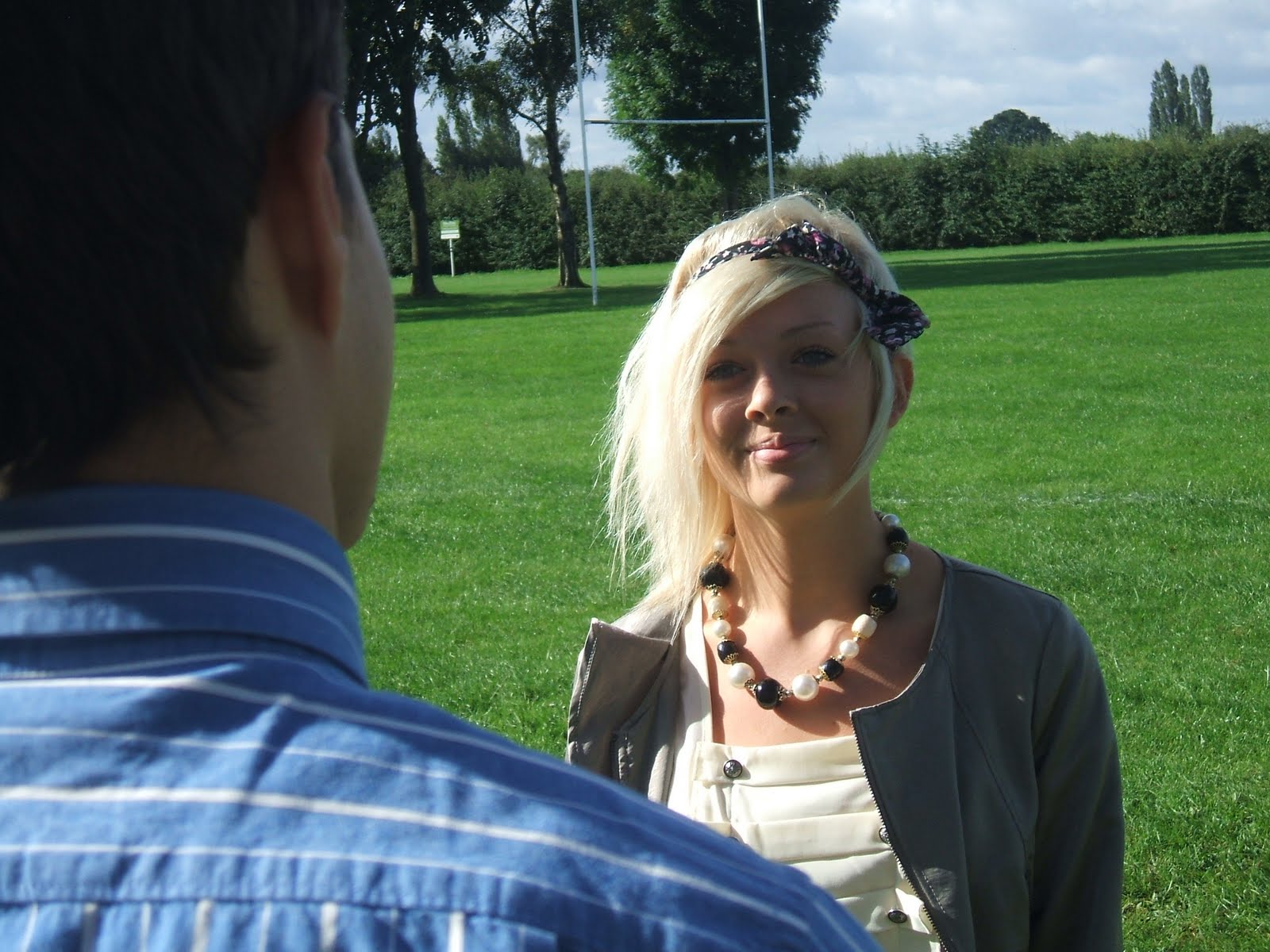
Over-the-Shoulder Shots - A shot that gives us a character's point of view but that includes part of that character's shoulder or the side of the head in the shot.


Cutaway - A brief shot that interrupts the main action of a film, often to depict related matter or supposedly concurrent action.


Point of View Shots - A short scene in a film that shows what a character is looking at. It is usually established by being positioned between a shot of a character looking at something, and a shot showing the character's reaction.


Examples:
Over-the-Shoulder Shot (A photo I took)


Point of View Shot: